The honest answer: a website costs what the work behind it costs. A one-page site for a local bakery and an online store that takes payments are completely different projects, so any single price you see online is either a guess or a sales trick.
This guide gives you something more useful than a guess. You will see exactly what you pay for, the four common types of website, what pushes the price up, the costs most people forget, and how to get a fixed quote you can trust. It works whether your business is in Lahore, Dubai, London or New York.
The short answer
The cost of a website comes from five things:
- Design: how the website looks and how people move through it.
- Building: turning that design into a fast, working website on every phone and computer.
- Content: the words and photos on every page.
- Features: anything beyond pages, such as bookings, property listings, online ordering or payments.
- Running costs: the domain, hosting, email and looking after the website every year.
The more pages and features a website needs, the more design and building time it takes, and that time is most of the price. A simple landing page is the smallest project. A website that takes payments or runs your bookings is a much bigger one.
The four common types of website
1. A landing page
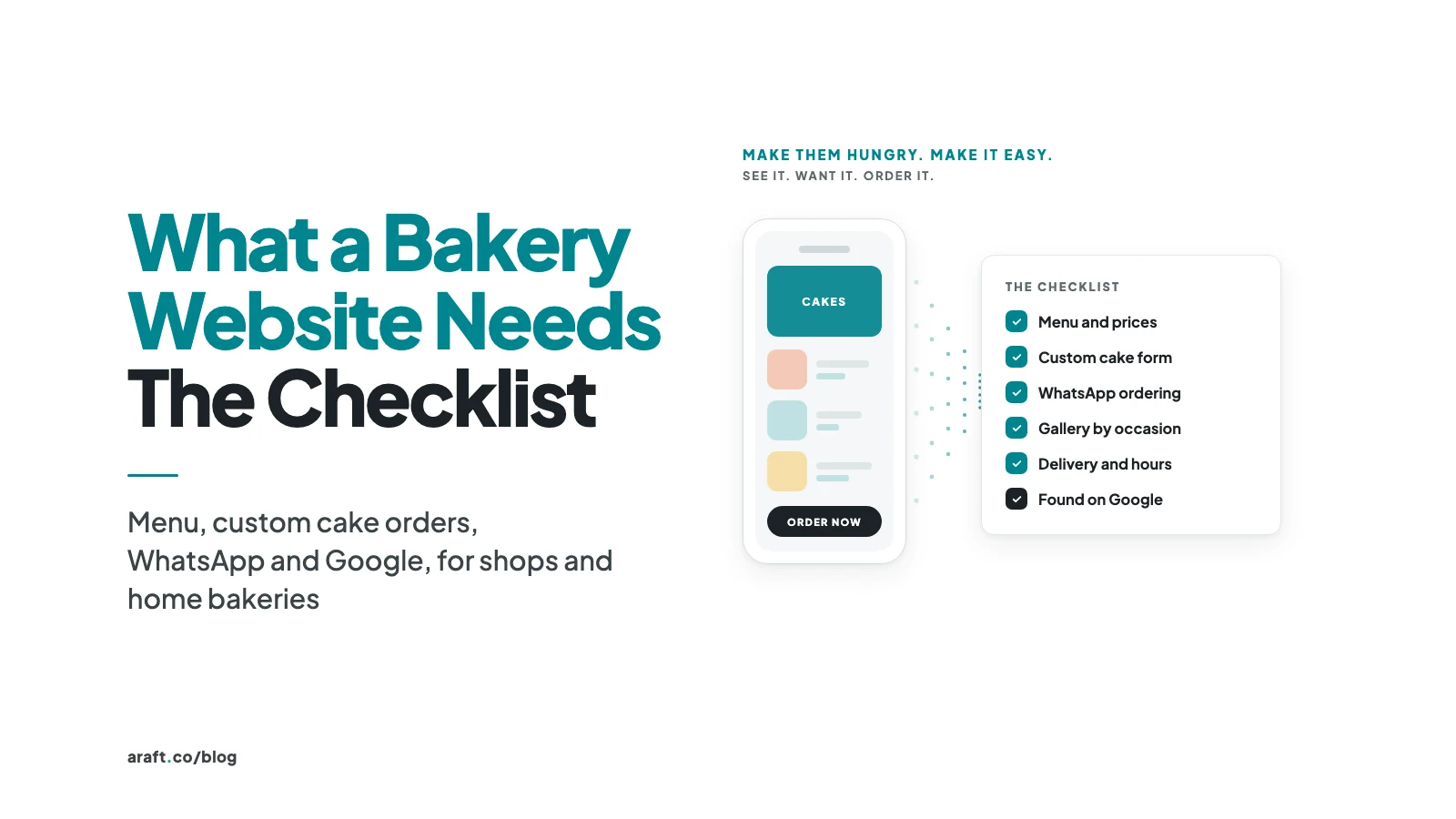
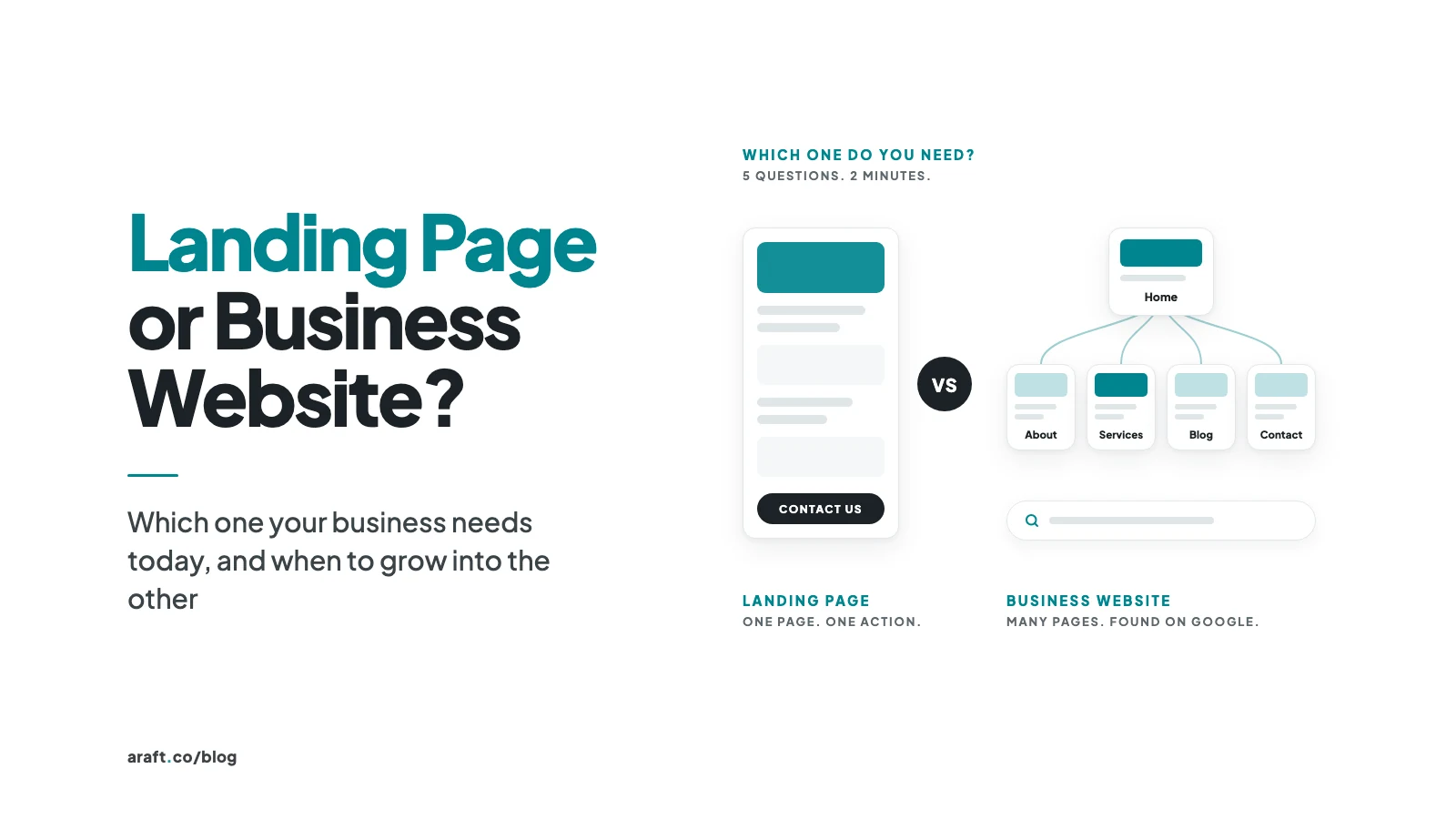
One long page that explains what you offer and gets people to call, message or order. It suits a new business, a single product, a campaign or an event. It usually has your services, a few photos, reviews, a contact form, a WhatsApp button and your location. At Araft, a landing page is usually ready in 5 to 7 working days after you send your details.
2. A business website
Several separate pages, for example Home, About, Services, a blog and Contact. Each page can be found on Google on its own, which matters if you want customers to find you through search. This is what most established small businesses need. At Araft, a business website with up to 5 pages is usually ready in 10 to 14 working days.
3. A website with bookings, listings or ordering
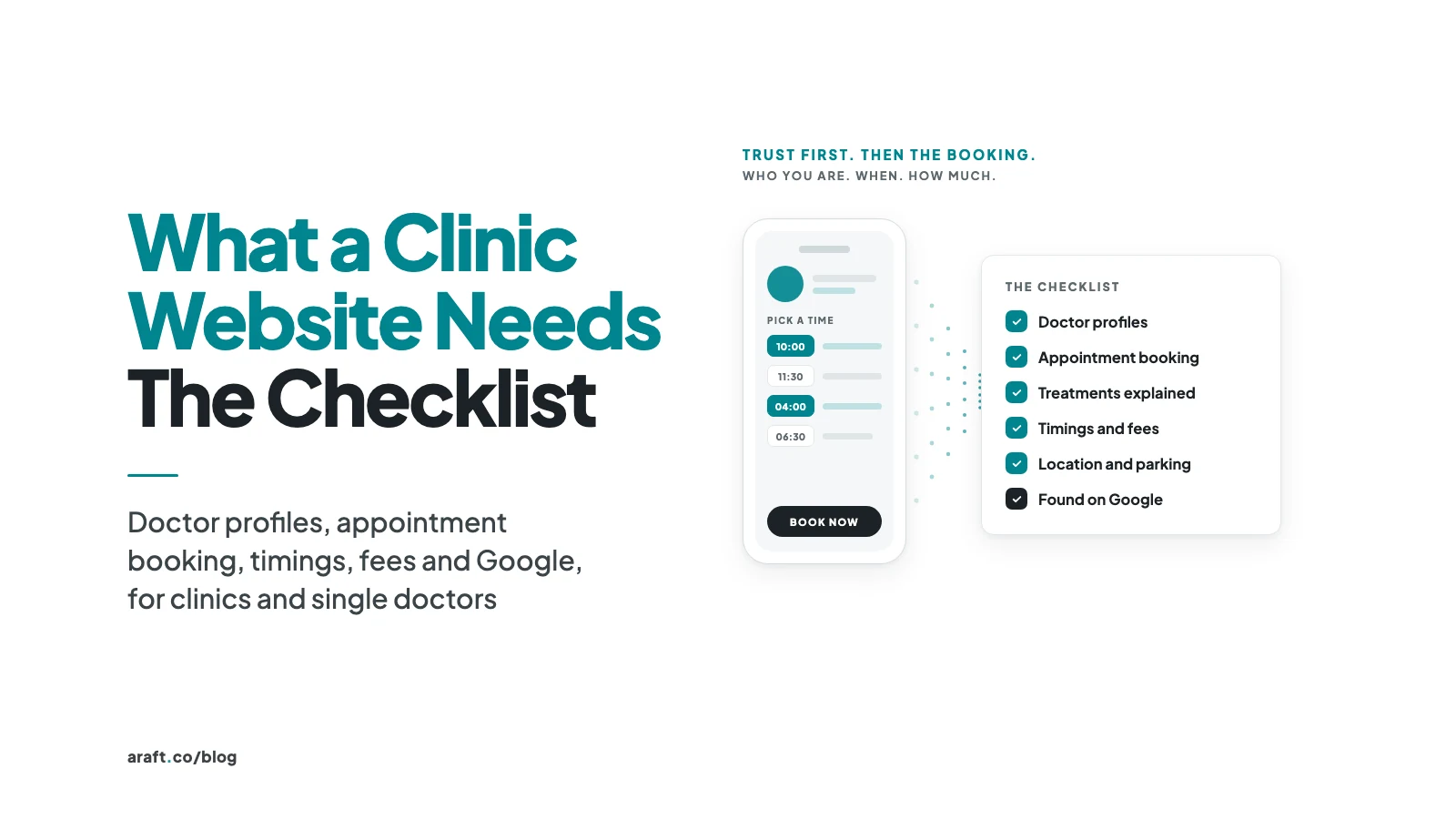
Clinics that take appointments, salons that take bookings, real estate agencies that list properties with search, restaurants that take orders, schools that take admissions. These need extra screens, forms and rules behind them, so they take longer to plan, build and test.
4. An online store or a custom web app
Selling products with stock, a shopping cart and online payments, or software your team logs into every day. These are projects in their own right, with security, payments and data to get right, and they are priced on their exact scope.
What makes the price go up
- More pages: every page needs its own design, text and checks.
- A custom design instead of a template: a template is cheaper to start with, a custom design fits your brand and your customers exactly.
- Features: bookings, payments, searches, member areas and connections to other software all add building and testing time.
- Writing the text and finding photos: if you have your own text and photos, the project is quicker. If you want them written and sourced for you, that is extra work.
- More than one language: for example a website in both English and Urdu, or English and Arabic.
- A tight deadline: faster delivery means more people working on it at the same time.
The costs people forget
Most surprises come after launch, not before. Plan for these from day one:
- The domain: your web address, such as yourbusiness.com. It is renewed every year. A .com domain usually costs somewhere around 10 to 20 US dollars a year, depending on the company you buy it from. Keep it in your own name.
- Hosting: where the website lives. Simple, modern websites can often be hosted for very little, while busy websites and online stores need paid plans.
- Business email: an address like you@yourbusiness.com. Services such as Google Workspace and Microsoft 365 charge per person, per month.
- Looking after the website: updates, fixes, backups, security and small changes. A website that nobody looks after slowly breaks and drops on Google.
- Bringing visitors: a website does not bring customers on its own. Plan for Google Business Profile, social media, ads or all three.
What AI changes about the cost of a website
AI website builders can now put together a basic page in minutes, and for a quick, simple page that can be enough. For a website that has to bring in customers, AI helps but does not replace the work that decides the result.
- Where AI saves time: first drafts of layouts and text, resizing and editing images, and translations. Good agencies use it to move faster.
- What still needs people: knowing your customers, a design that looks like your brand instead of a template, accurate text about your business, setting it up properly for Google, and checking it works on every phone.
- AI features on your website: a chat assistant that answers customers is a running cost. AI providers charge for every use, so the cost grows with your visitors and belongs in your monthly budget.
Website builder, freelancer or agency?
There is no single right choice. It depends on your time, your budget and how much the website matters to your business.
- A do-it-yourself website builder is the cheapest way to start, and fine for a simple page. The catch is your time: you do the design, the writing, the Google setup and every fix yourself.
- A freelancer can be a good middle ground for a clearly defined website. Ask who will look after it after launch, and what happens if they are busy or unavailable.
- An agency costs more than doing it yourself, but you get design, building, Google setup, launch and ongoing care from one team that stays responsible for the result.
How to get an accurate, fixed quote
The fastest way to a price you can trust is to describe your business well. Before you ask anyone for a quote, write down:
- What your business does, and who your customers are.
- Your main products or services.
- What the website should do most: get calls, take orders, take bookings or show your work.
- The pages and features you need.
- Whether you have a logo, brand colours, text and photos.
- Whether you already own a domain.
- When you need it, and your budget range.
- Two or three websites you like, and why.
A good agency or freelancer will turn that into a written plan with a fixed price, not an open-ended hourly bill.
How we price websites at Araft
We do not publish one price for every website, because a bakery and a real estate agency need very different things. This is how it works instead:
- You tell us about your business in a short form. It takes about five minutes and asks exactly the questions above.
- We study it and reply within one business day with a plan and a fixed quote. There is no payment and no obligation at this stage.
- You see the design first and ask for changes before we build it.
- We launch it on your own domain, which stays in your name, and show you how everything works.
- After launch, we can host, maintain and manage the website for you every month, so it stays fast, safe and up to date.
We make websites for businesses all over the world, fully online. If you want to see what a website for your kind of business would have, start with our pages for bakeries, clinics, restaurants, real estate agencies and every other kind of business.
Questions people ask
Is a website a one-time cost?
The design and building are usually a one-time cost. The domain, hosting and email are yearly or monthly costs, and most websites also need someone to look after them after launch.
Can I start small and grow later?
Yes. Many businesses start with a landing page and add pages, a blog or bookings later. If you plan for that from the start, growing the website later is quicker and cheaper.
How long does it take to make a website?
At Araft, a landing page is usually ready in 5 to 7 working days and a business website with up to 5 pages in 10 to 14 working days, after you send your details. Websites with bookings, listings or payments take longer, and you get an exact timeline in the plan.
Do I need to buy the domain myself?
It is best if the domain is in your own name, so you always own your web address. If you do not have one yet, we help you choose and buy it, then connect your website to it.
Can AI build my website for free?
AI tools can make a basic page quickly, often for little money. A website that brings customers still needs a real understanding of your business, a design that fits your brand, accurate text and a proper Google setup, and that is the work you pay a team for.
Will my website show up on Google?
A well-built website is set up for Google from day one, with clear titles, your services and your city on every page. Showing up higher also depends on your Google Business Profile, your reviews and how long your website has been live.