Two years ago, companies asked us what a brand project would cost.
Today many ask a different question first. Our team already uses AI. Why do we need an agency at all?
It is a fair question. It deserves a fair answer, not a defensive one.
So this is not an article about AI being bad. We use AI every day. It is very good at many things. This is about the numbers most companies never add up and where the real bill arrives.
First, the honest part: AI is genuinely useful
AI has made some work almost free.
A moodboard used to take a designer two days. Now it takes twenty minutes. First-draft copy, background removal, resizing one image into fifteen social formats, translating a landing page, writing fifty headlines for testing all of this is now fast and cheap.
For many repetitive production tasks, not using AI now means leaving real efficiency on the table.
The problem is not the tool. The problem is a belief that has spread with it: if we have the tool, we have the skill.
Those are two different things. And the gap between them is where companies lose money.
Cost one: the tools (small, but not zero)
Start with the easy number. Here is what a six-person marketing team typically pays in 2026:
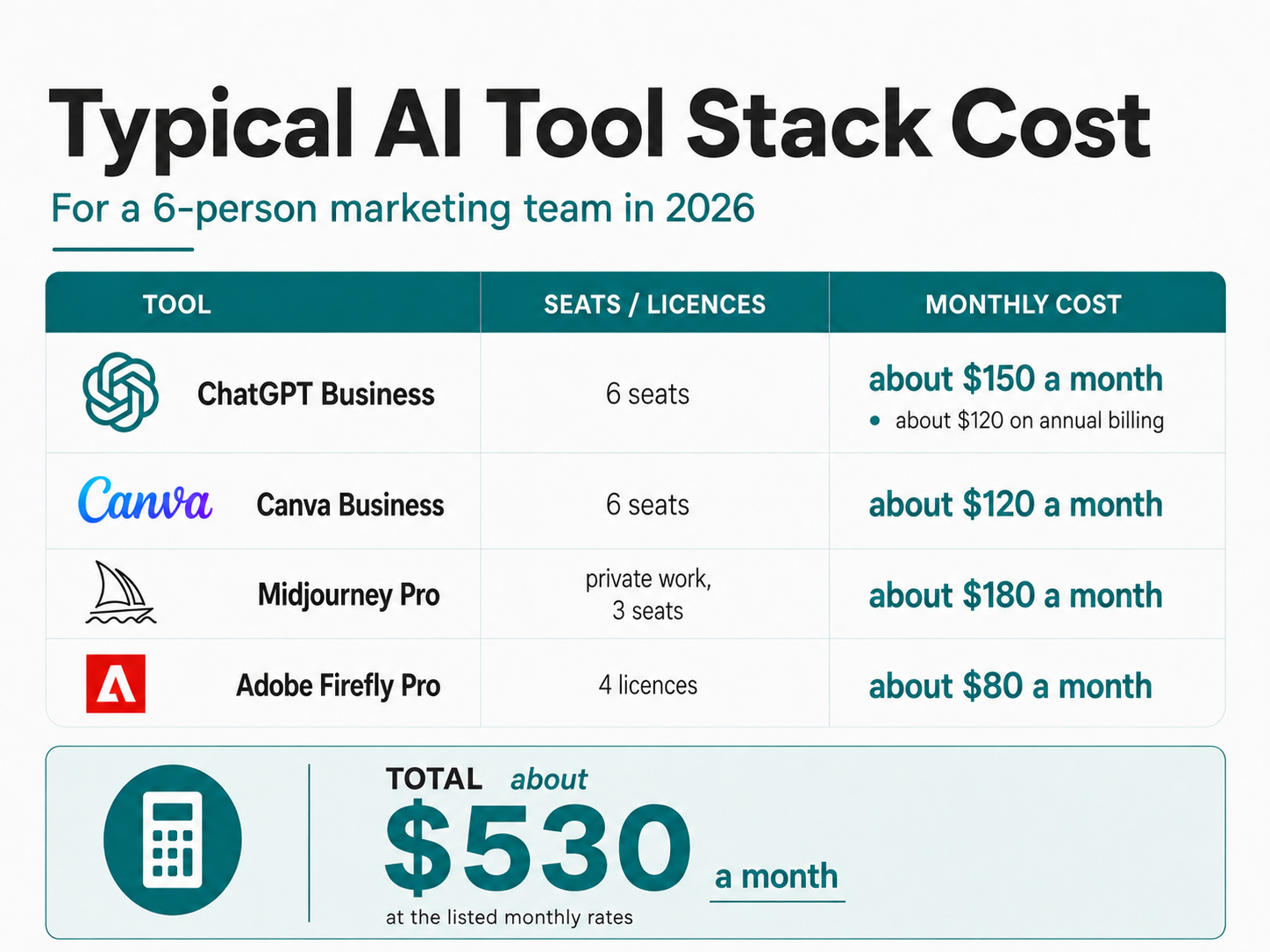
That is roughly $6,400 a year at these rates. Annual commitments can reduce the total further. Prices change often and vary by region, so treat this as a guide, not a quote.
For a serious company, this is a small number. That is the point. For a team like this, the software is rarely the expensive part. People assume the cost of doing it in-house is the subscription. It is not. It is everything below.
One detail worth knowing, because teams find it out too late: some of these tools meter heavier generative work through credits or compute time, and those allowances can disappear faster than teams expect. In Midjourney, one image prompt typically uses about one minute of GPU time, while a batch of four HD videos can use around 26 minutes. In Adobe Firefly, the Pro plan gives 4,000 credits, and a five-second video clip costs around 100 of them about forty clips a month. Private generation also costs more. On Midjourney, work stays private only on the higher plans. On cheaper plans, your unreleased concepts sit in a public gallery.
Cost two: your team's hours (this is the big one)
This is the number almost nobody calculates.
Say six people each spend five hours a week generating, reviewing and fixing AI work. That is 30 hours a week. Over a year, that is 1,560 hours.
Now put a value on those hours: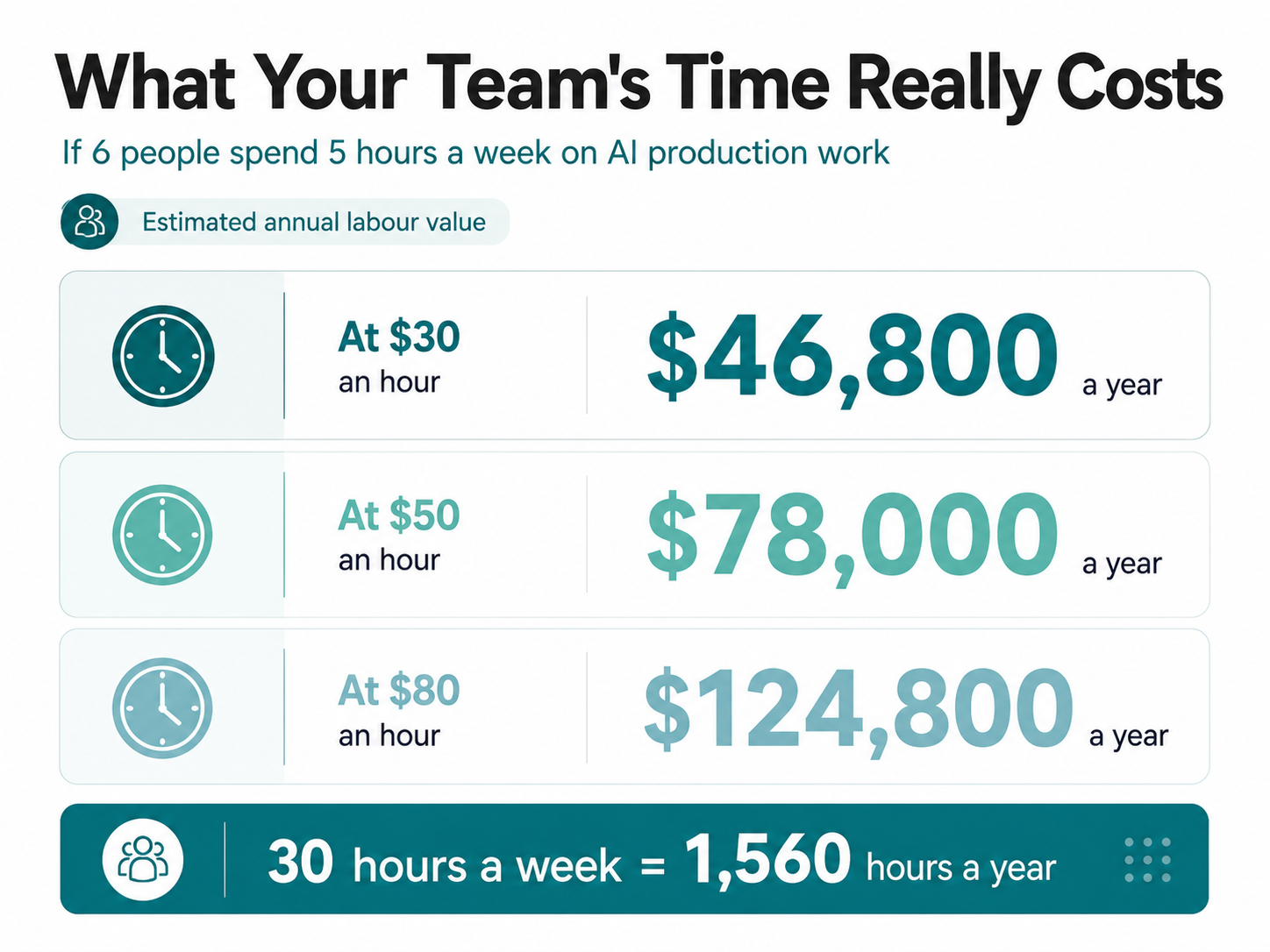
Under those assumptions, that is roughly $47,000 to $125,000 a year in labour value before software costs.
Those hours also carry an opportunity cost. They could have gone into campaigns, customers, product or sales. Every hour spent regenerating a banner is an hour not spent growing the business.
Cost three: rework (the one that hurts)
Here is the pattern we see again and again.
A team generates work with AI. It looks good on screen. It goes live. Months later, a problem appears.
The logo becomes unreadable at small size on a phone. The colours look wrong in print. A file exists only as an image, so it cannot be resized properly. Twelve markets have made twelve slightly different versions of the same brand. A lawyer raises a question about a mark that looks too close to someone else's.
Now the work is redone. But this time it costs more, because the old version is already printed, published, and known by customers.
Companies that optimise only for the cheapest first version can end up paying twice.
Why the hours keep growing
The deeper issue is simple, and it explains everything above.
AI can answer the question you asked. It cannot reliably know which important questions you failed to ask.
An expert does not mainly create options. An expert removes them. Before a mark is even drawn, they already know it must work as a tiny app icon, work in one colour on an invoice, work stitched on fabric, and work in print where a bright screen colour turns dull. They know a font needs a commercial licence. They know an image file is not a logo.
Someone without that training may not know all of these constraints exist, which means they may never think to ask about them. They keep prompting, keep liking things, and keep discovering problems later.
The expert is not faster because they type faster. They are faster because they know which paths not to take.
If you are the owner, the cost is higher again
There is a version of this problem that only affects the person at the top.
A founder's job is direction. Decide where the business is going. Decide who you are selling to. Build relationships. Plan growth. Hire people and make them good at their work.
Doing the work yourself is not a bad thing. In the early days, every owner does everything. That is normal, and often necessary.
But there is a point where it quietly becomes expensive. And AI has moved that point closer, because it makes small tasks feel fast and even enjoyable. So the owner keeps doing them.
Run the numbers on yourself the same way we ran them on the team.
Say you spend ten hours a week making posts, fixing graphics and prompting for banners. That is about 500 hours a year. Now ask a simple question: if those 500 hours had gone into sales conversations, partnerships and planning, what would they have produced? If your average client is worth $20,000 and those hours brought in even two more, that is potentially $40,000 in foregone revenue while you were saving a few hundred dollars in production.
There is a second cost that is easier to miss. When the owner does the work, nobody else learns to do it. No system gets built. No one gets trained. The business stays dependent on one person, and that person becomes the ceiling.
So the question is not can I do this myself? With AI, you probably can. The better question is is this the most valuable thing I can do with this hour?
For many company leaders, the answer will often be no.
Who owns what you generate?
This part surprises people, and in the United States the legal position is now relatively clear.
In the United States, copyright needs a human author. Material made purely by AI does not qualify. If you register work that contains a meaningful amount of AI-generated content, you must disclose it and leave the AI parts out of your claim.
The courts have agreed. The D.C. Circuit upheld this in the Thaler case in March 2025. The Supreme Court declined to hear the question in March 2026.
For a large company, this matters more, not less. Trademark rights work under a separate system and mostly come from real commercial use, so this is not the whole picture. But if you ever need to stop a competitor from copying your identity, you want your legal position to be as strong as possible.
One more point, and we will be precise about it. Not every agency transfers rights to you automatically. It depends on the contract. A properly written agreement gives you a clear assignment or licence of rights, plus real source files. A software subscription gives you an output and a terms-of-service page. Ask to see that clause before you sign anything including with us.
What your customers think about AI
Many companies assume customers do not care. The research says they do.
A Klaviyo study with Datalily surveyed 8,000 consumers across eight countries in December 2025. Only 7% said visible AI-generated marketing made them trust a brand more. 31% said it made them trust the brand less.
A Harris Poll released in June 2026 found 63% of consumers were less likely to buy from a brand using AI-generated ads. 73% were less likely to trust an ad they thought was made by AI. A 2026 Gartner survey found half of US consumers would rather buy from brands that do not use AI in customer-facing content. IAB research found 71% of younger consumers believe they have already seen an AI-made ad, up from 54% in 2024.
The lesson is not "never use AI". The lesson is that AI belongs in your production process, not in your shop window. There is a big difference between AI helped make this and this obviously looks AI-made.
Knowing where that line sits is a skill. It is not in the software.
What the research says about doing it alone
MIT Project NANDA published a research report in 2025 called The GenAI Divide: State of AI in Business 2025. The report said 95% of organisations in its analysis were getting zero measurable return from generative AI, despite an estimated $30–40 billion in enterprise investment. Only 5% of integrated AI pilots were extracting significant measurable value.
We will be fair about that number. It came from 52 organisation interviews, 153 senior leader surveys and around 300 public initiatives. The report describes itself as preliminary and limited by that sample, so read the figure as a signal rather than a hard fact.
But another finding in the same report matters more here. In its interview sample, external partnerships using learning-capable, customised tools reached deployment about 67% of the time, compared with about 33% for internally built tools.
Again, honestly: those results were self-reported, and this does not prove that partners cause success. Companies that hire help may simply have clearer goals from the start.
Still, the direction is hard to ignore. In most of these cases, the model was not the problem. The missing piece was someone who had done the work before.
Where this leaves you
The honest summary is not "AI bad, humans good". It is this:
AI has made execution cheap. It has not made judgement cheap.
Making a hundred logos now costs almost nothing. Knowing which one will still work in five years, across every market, at every size, and in front of a customer who is quietly deciding whether to trust you that has not become cheaper at all. It was never a production problem.
The companies losing money right now are not the ones using AI. They are the ones who thought access to the tools was the same as having the skill.
At Araft, we use AI daily, and it makes parts of our work faster. We pass that speed on. What we do not do is let a tool make a decision that a client will live with for the next decade. Every piece of work that leaves this studio has a person behind it who understood the brief, made a judgement, and stands behind it.
If your team is already using AI and something still feels off, we are happy to look at it and tell you honestly what is missing. Sometimes the answer is that you need a partner. Sometimes the answer is better direction for the team you already have. We will tell you which one it is.
Prices and survey figures were checked in August 2026 and change often. Please confirm current pricing before you budget. This article is not legal advice speak to a qualified IP lawyer in your country about ownership questions.
Araft LLP is a branding, design and creative partner studio working with clients worldwide.